
There are currently a lot of blank walls in our house. We moved in a few months ago, and despite the fact that I have approximately 64 ideas for what I eventually want to do with every room? Most of those ideas are still exactly that… ideas. There are rooms that need furniture, walls waiting for art and photographs, corners I haven’t figured out yet, things I’d like to replace, and things I know would make each space feel more finished.
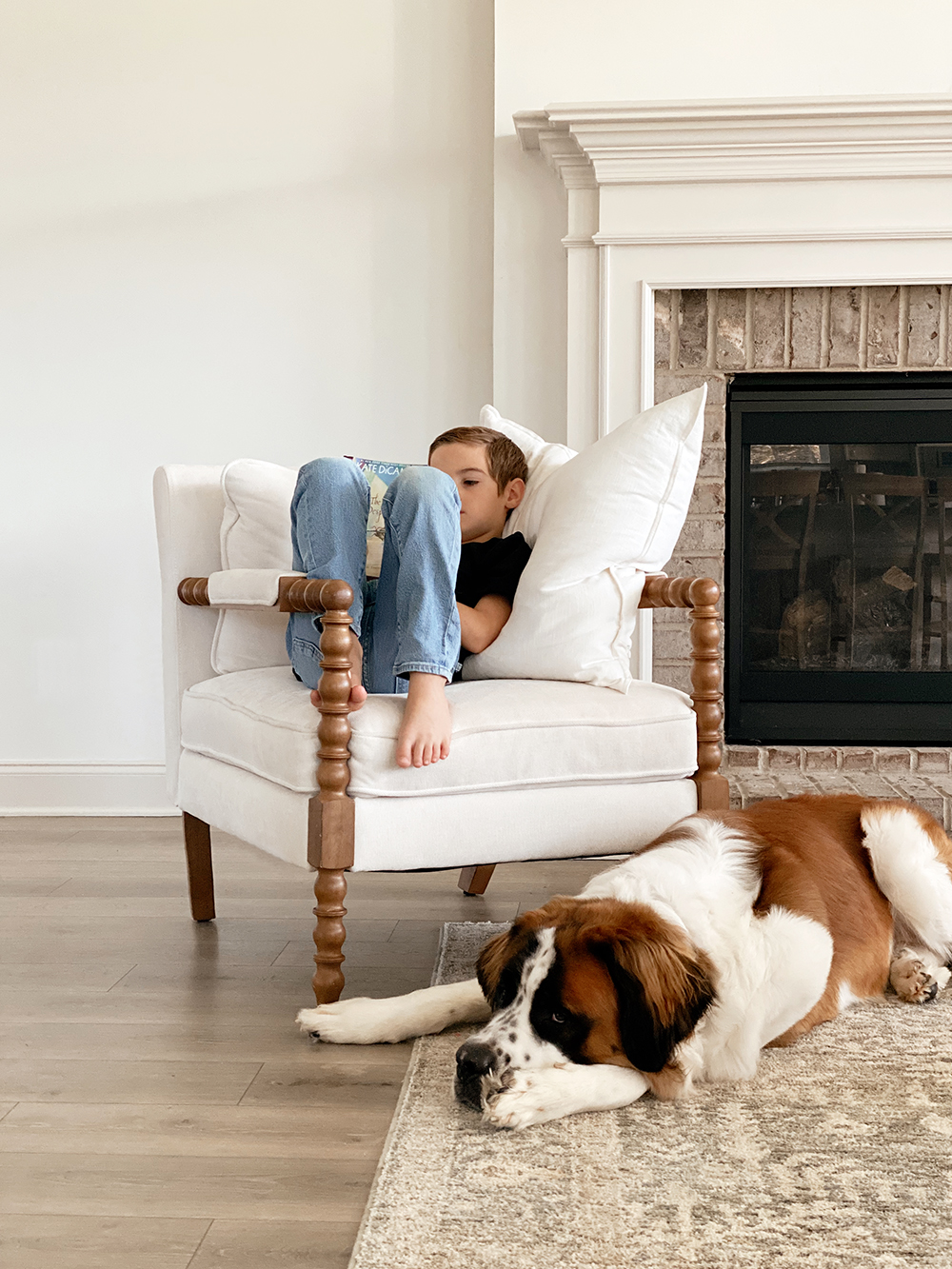
And yet, the other afternoon I looked over and saw my youngest curled up with a book, the dog at his feet. Nothing about the room was finished, but the moment was. And that has been on my mind ever since. Because for someone who has spent a large part of her career thinking about design, I’ve always understood the power our surroundings have over how we feel. But the older (and wiser) I have gotten, I’ve become less interested in homes that simply look beautiful and much more interested in homes that help us live beautifully.
Homes that make it easier to gather, to rest, to cook something without rushing through it, to pick up a book, to linger a little longer at the dinner table. You know, to exist for a few minutes without feeling like there is somewhere else we should be.
Maybe that’s what I’ve been craving lately. Not a perfectly finished home. Just an unhurried one.And lately, that kind of ease feels like its own version of luxury.
We’ve Designed Everything to Be Faster
Modern life is ridiculously ironic. We have spent decades inventing things designed specifically to save us time, and somehow? We seem to have less of it than ever.
Our groceries can arrive at the front door. Our lights can turn themselves on. Our vacuums can clean the floors while we’re doing something else. We can order almost anything we want without putting shoes on. And still? So many of us walk around feeling like we are eternally behind.
Our homes have become incredibly efficient. However, I’m not sure they’ve become equally good at helping us slow down. And there is a difference between efficiency and ease. Efficiency asks how we can do more with our time. Ease asks whether we need to at all.
And lately? I’m far more interested in the second question. Because truth be told, I don’t necessarily want a home that helps me squeeze three additional tasks into an afternoon. I’d rather have one that occasionally convinces me I don’t need to.
An Unhurried Home Isn’t an Empty One
Of course, the internet has already given “slow living” an aesthetic. You know the one. Where everything is linen and beige. Someone is always kneading bread. There are handmade ceramics, baskets filled with things that somehow look beautiful in baskets, and a single branch clipped from the garden resting casually in a vessel that costs upwards of $200. There are no charging cords. No junk mail. No plastic cups from sporting events. No unexplained pile of things waiting at the bottom of the stairs. And definitely no 400-count bottle of gummy vitamins from Costco sitting on the counter absolutely annihilating the visual narrative.
Slow living, apparently, has excellent art direction.
It’s a lovely idea… but not exactly my house. And maybe not yours either?
There are seven people who belong to this family, six still at home. There are shoes. There are art projects. There are books and studies stacked in places where they probably aren’t supposed to be stacked. And there is laundry that seems to multiply overnight. Life leaves evidence and I’m not convinced the goal should be removing all of it.
I think there is a difference between the clutter that makes a home feel noisy and the beautiful mess that simply says people live here. It’s the blanket left on the sofa because someone was cold. A book left open beside a chair. Tomatoes sitting on the counter from the farmer’s market. Shoes kicked off near the door. A puzzle that takes over the table for three days.
These things don’t make a home feel hurried to me. If anything? They make it feel alive.
The things I’m paying more attention to are the ones that quietly create mental friction (a much nicer way to say the things that make me slip slowly into madness). I’m talking about the pile I walk past six times and think, I really need to deal with that. The cabinet so overstuffed that reaching for one thing requires moving five others. The objects we keep shifting from one place to another because they don’t actually have a place.
It’s not about eliminating evidence of life. It’s about noticing what is constantly asking something from us in our homes.
Make the Life You Want Easier to Live
I’ve started thinking about my home less in terms of what it needs to have and more in terms of what I want us to do here.
I want us to read. I want people to linger around the kitchen while dinner is being made. I want evenings that feel noticeably different from afternoons. I want conversations that stretch longer than expected. I want music playing. I want the people I love to feel like they can walk in and melt into the comfort of home.
And if those are the things I say matter to me personally, then perhaps the approach I take in designing our home should make those things easier. Right?
Books should be within reach. The chairs we actually want to sit in should be where the good light is. Blankets should be somewhere people can grab them (a great way to do that right here). The counter shouldn’t permanently function as storage. The things we use every day shouldn’t require pulling out half the cabinet while quietly becoming furious at everyone you live with.
None of this is groundbreaking design advice, I know that. But that’s sort of the point. Sometimes designing a life well isn’t about making dramatic changes. It’s about removing tiny obstacles between ourselves and the way we keep saying we want to live.
Let a Home Have Its Rhythms
Some of my favorite parts of home have very little to do with the things inside it. Some of my favorite parts of home are the rhythms.
It’s opening the curtains in the morning and letting the natural light spill into every room. It’s the music playing while dinner is being made. The sound of someone unloading the dishwasher while someone else is talking from across the kitchen. Turning lamps on as the afternoon grows late. Cleaning the kitchen after dinner and knowing the day is winding down. Everyone slowly making their way upstairs when all is said and done.
These things are ordinary enough that we overlook them all the time. But perhaps that’s exactly what makes them important. We tend to think rituals need to be intentionally created. Morning routines. Evening routines. Sunday routines. All perfectly optimized. But homes develop rituals all on their own. The question is whether we’re paying attention to them.
I don’t need a twelve-step evening routine. I just like knowing that at some point the lamps come on, the kitchen gets cleaned, and the house starts settling in for the night.
Leave a Little Breathing Room
There is a tendency, especially when you love design, to think that every space needs an answer. What goes on this wall? What should be in that corner? What does this shelf need? What should I buy for this room? I’ve been sitting with more unanswered questions in this house partly because we just moved in this summer. And partly because our house doubled in size and, rather inconveniently, our furniture budget did not. But also because I’m beginning to appreciate what happens when you don’t rush to fill every space.
You notice how you actually use the room. You find out where everyone naturally sits. You see where things accumulate and where they don’t. You realize the piece of furniture you thought you needed might not be necessary at all. You discover that an empty wall is, in fact, not an emergency. That maybe it’s better to live with it for awhile than buy something you only sort of like because you were impatient to call the room finished.
Maybe our homes need a little breathing room too. A little space that hasn’t been decided yet.
Create Places That Invite You to Stay
When I think about the homes I’ve loved being in the most, I don’t remember whether they had the right coffee table. I remember how they made me feel.
There was somewhere comfortable to sit. Someone told me to stay for dinner like they were planning for it all along. There were drinks in the kitchen and people talking with one another. Maybe music was playing. Nothing felt particularly precious, but you could settle in as if you had been there many times before.
I think that’s one of the greatest compliments a home can receive. Not “It’s beautiful”. But instead, “I didn’t want to leave”. And creating that feeling doesn’t necessarily require more square footage, better furniture, or an interior designer. Sometimes it means noticing where life is already happening and making that place just a little better.
Pulling another chair over. Keeping the blanket nearby. Clearing enough room on the table. Turning on the lamp instead of the overhead light (never the overhead light). Putting your phone somewhere else. Just… staying.
A Home Doesn’t Have to Be Finished to Be Good
Don’t get me wrong, I still want to finish this house. I want photographs on the walls. I want to find just the right pieces. There are rooms I can’t wait to change and ideas I’ve been saving since before the moving boxes were unpacked. I love beautiful things. I love good design. None of that has changed.
But I don’t want to spend the next year looking around at everything that isn’t finished and accidentally miss what is already happening within these walls already.
Because the house is already doing its most important job. People are living in it. They’re reading books curled up in armchairs. They’re making food in the kitchen. They’re leaving shoes by the door, and blankets on the sofa, and glasses beside their beds. They’re growing up here.
And maybe that’s the real luxury of an unhurried home. Not a house where nothing needs to be done. I mean, there will always be something that needs to be done. Another load of laundry. Another drawer to organize. Another wall to paint. Another project waiting its turn.
The luxury is knowing that despite everything that still needs doing, you can stop. Sit down. Stay awhile.
And remember that a beautiful home was never really the point.
A beautiful life happening inside of it was.
Leave a Reply


WEEKLY EDIT
COMMENTS +
Share: